The Developer's Guide to Casing Conventions: camelCase, snake_case, PascalCase, and kebab-case
1. Introduction: Why Casing Dictates Software Quality
In modern computer programming, source code is read far more frequently than it is written. Software engineers spend hours navigating vast codebases, tracing function call graphs, and debugging complex distributed state. In this environment, visual consistency is not merely an aesthetic luxury—it is a critical cognitive aid that communicates architectural intent.
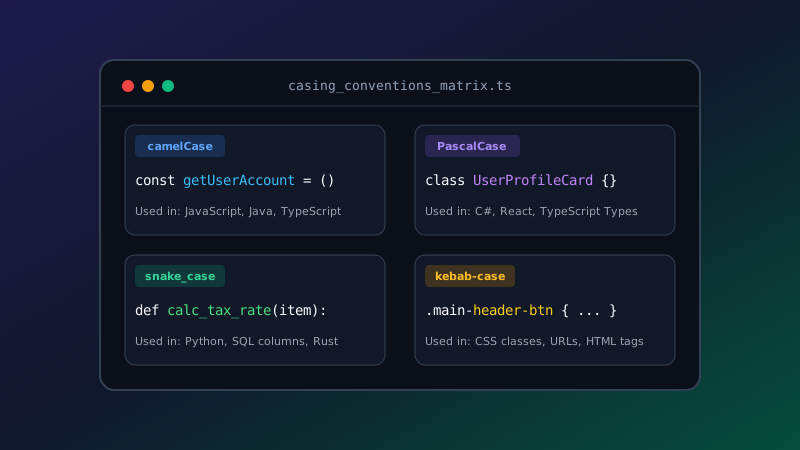
When you see userProfile, UserProfile, user_profile, or user-profile, the human brain registers four distinct syntactic entities before reading a single line of accompanying logic. Each casing convention carries rigid cultural conventions established over decades of software engineering history. Mixing these paradigms haphazardly introduces subtle runtime bugs, confuses automated linters, and increases onboarding friction for new engineering hires.
2. Lexical Parsing: Why Spaces Cannot Exist in Identifiers
To understand why casing conventions arose, we must examine how compiler lexers and interpreters tokenize raw source code. When a compiler parses a statement such as let user account balance = 100;, the whitespace characters serve as structural delimiters. The lexer interprets user, account, and balance as three distinct, consecutive token identifiers, resulting in an immediate fatal syntax error.
Because variables, functions, types, and classes must represent singular, unbroken lexical tokens, early computer scientists needed mechanisms to concatenate multiple natural language words into a single identifier without sacrificing readability. The two primary paths that emerged were capitalization boundaries (camelCase, PascalCase) and delimiters (underscores in snake_case, hyphens in kebab-case).
3. camelCase: The Backbone of JavaScript and Web APIs
In camelCase (specifically lower camelCase), the identifier begins with a lowercase letter, and every subsequent concatenated word begins with a capitalized letter, with zero intervening spaces or punctuation (for example: fetchUserData, calculateTotalRevenue, isSessionActive).
camelCase is the predominant naming standard across:
- JavaScript and TypeScript: Standard for all primitive variables, object properties, and function declarations.
- Java: Strictly mandated by Oracle's official Java Code Conventions for method and field names.
- Swift and Kotlin: The native convention for mobile application developers building on iOS and Android platforms.
One perennial edge case involves acronyms. Should a JSON parser function be named parseJson() or parseJSON()? Most modern style guides (including Google and TypeScript standards) recommend treating multi-letter acronyms as standard words (parseJson, fetchHttpUrl) to avoid illegible sequences like parseXMLHTTPResponse.
4. PascalCase: Structuring Types, Classes, and Components
In PascalCase (also known as UpperCamelCase), every single word begins with an uppercase letter, including the very first character (for example: OrderProcessingService, UserProfileCard, DatabaseConnectionPool).
Originally popularized by the Pascal programming language in the 1970s, PascalCase is now universally recognized as the visual indicator for constructible types, object-oriented classes, and declarative UI components:
- React & Vue Components: In React JSX, lowercase tags (
<div>,<span>) represent native HTML DOM elements, while PascalCase tags (<CheckoutModal>) denote custom React component functions. A casing mistake here breaks the entire rendering tree. - C# and .NET: Microsoft's C# engineering guidelines mandate PascalCase for class names, methods, properties, and public interfaces (e.g.,
IComparable). - TypeScript Interfaces & Enums: Type definitions like
type UserState = 'ACTIVE' | 'PENDING'rely on PascalCase to distinguish types from runtime values.
5. snake_case: Database Schemas, Python, and Low-Level Systems
In snake_case, words are joined by lowercase letters separated exclusively by underscores (_) (for example: user_id, created_at, process_payment_batch). When written in all caps (MAX_RETRY_ATTEMPTS), it is known as SCREAMING_SNAKE_CASE, universally reserved for global immutable constants and environment variables.
snake_case is irreplaceable in:
- Python (PEP 8): Python's official style guide specifies lowercase snake_case for all module names, functions, and variable instances.
- Relational SQL Databases: Database engines (PostgreSQL, MySQL, SQLite) frequently fold unquoted identifiers to lower case. Using snake_case for column names (
first_name,billing_address_id) prevents cross-database capitalization mismatches. - Rust and C: System-level languages rely on snake_case for function definitions and crate packages.
6. kebab-case: The Universal Standard for URLs and CSS
In kebab-case (also called spinal-case or dash-case), lowercase words are linked by hyphens (-) (for example: primary-navigation-bar, user-settings-tab).
Because the minus sign doubles as the mathematical subtraction operator in virtually every programming language, let user-name = "Alex"; is rejected by compilers as user minus name. However, kebab-case thrives in markup and stylesheet languages:
- CSS Selectors: Class names (
.btn-primary,.hero-header-title) and CSS custom variables (--bg-surface) use kebab-case universally. - Web URLs and SEO Slugs: Google's search crawling documentation explicitly recommends hyphens over underscores in URL path structures (e.g.,
https://ollrite.com/tools/word-character-counter.html) because search parsers treat hyphens as clean word separators. - Custom HTML Web Components: The W3C HTML specification legally requires custom elements to include a hyphen (e.g.,
<user-card>) to avoid namespace collisions with future native HTML tags.
7. The API Boundary Problem: Managing JSON Serialization
The most frequent friction point in full-stack web development occurs at the API boundary. A Python Django backend or PostgreSQL database generates snake_case keys (user_profile_url), which are transmitted via JSON payload to a TypeScript React frontend that expects camelCase properties (userProfileUrl).
When frontend developers access data.userProfileUrl, the property evaluates to undefined because the API emitted data.user_profile_url. Full-stack teams resolve this by either configuring automated serialization middleware (such as Pydantic in Python or Zod in TypeScript) or utilizing in-browser string converters during rapid testing.
8. Automating Casing Transformations & Linters
Manually rewriting dozens of database columns or API variable names is slow and error-prone. Modern engineering teams enforce casing standards using static analysis tools:
- ESLint: The
@typescript-eslint/naming-conventionrule automatically flags variables that violate team casing conventions during pull request audits. - Pre-Commit Git Hooks: Verify file naming conventions (such as ensuring all React components use PascalCase filenames) before commits are accepted.
- Instant In-Browser Converters: When refactoring legacy scripts or formatting API payloads, developers utilize our free Case Converter to switch between camelCase, snake_case, PascalCase, and kebab-case with a single click.
9. Conclusion: Choosing Consistency Over Preference
There is no universally superior casing style; each convention was engineered to solve specific lexical constraints within its host ecosystem. The golden rule of software engineering is local consistency: respect the idioms of the language and repository you are working in.
Need to quickly normalize database column names, generate SEO-friendly kebab-case slugs, or convert API payloads? Try our fast, 100% private Online Case Converter today.
Written by the ollrite Tools Editorial Team
We build fast, client-side developer utilities and publish deep-dive technical explorations into string manipulation, software algorithms, and web optimization. Have feedback? Email us at info@ollrite.com.