Text Diff Explained: How Developers Compare Code and Documents
1. Introduction: The Evolution of Document Comparison
In the earliest decades of computing, reviewing revisions made to a source code file or data table required an arduous manual audit: engineers sat side by side, reading line after line of printed punch cards or paper terminal rolls. As software systems scaled to encompass hundreds of thousands of lines of code, manual verification became entirely unsustainable.
In 1974, computer scientist Douglas McIlroy at Bell Laboratories authored the original Unix diff utility. That seminal program transformed software engineering forever. Today, text differencing underpins every modern version control system (Git, Mercurial, SVN), continuous integration pipeline, and digital legal redlining workflow. But how does an algorithm determine what has changed between two files?
2. The Mathematical Foundation: Longest Common Subsequence (LCS)
At its theoretical core, computing the difference between two files is an exercise in finding the Longest Common Subsequence (LCS). Suppose you have two strings: sequence $A$ and sequence $B$. A subsequence is a sequence that can be derived from another sequence by deleting zero or more elements without changing the relative order of the remaining elements.
Consider the classic example:
- Sequence A:
["apple", "banana", "cherry", "date"] - Sequence B:
["apple", "blueberry", "cherry", "date", "fig"]
The longest common subsequence shared between both arrays is ["apple", "cherry", "date"]. With this shared foundation established, the differencing engine reconstructs the exact transformation script:
- Keep
"apple"(unchanged). - Remove
"banana"(deletion from A). - Add
"blueberry"(insertion into B). - Keep
"cherry"and"date"(unchanged). - Add
"fig"(insertion into B).
By framing the problem around the maximum common backbone, the engine calculates the Shortest Edit Script (SES) required to convert file $A$ into file $B$. You can test this exact behavior inside your web browser using our Text Diff Checker.
3. The Myers Difference Algorithm in Modern Version Control
While standard dynamic programming can solve the LCS problem in $O(N \times M)$ time, real-world repositories with 10,000-line files would consume far too much computing memory. In 1986, Eugene Myers published a breakthrough paper titled "An O(ND) Difference Algorithm and Its Variations".
Myers visualized the edit problem as an edit graph where the horizontal axis represents operations on file $A$ and the vertical axis represents operations on file $B$. Moving right represents a deletion; moving down represents an insertion; moving diagonally down-and-right represents matching lines that cost zero edit penalty. Myers' algorithm finds the shortest path through this directed acyclic graph using a breadth-first search heuristic that finishes in $O(ND)$ time, where $D$ is the total number of differences between the files. Because most software edits touch only 1% to 5% of a file, $D$ is typically very small, allowing Git to compute commits in milliseconds.
4. Understanding Diff Formats: Unified vs. Side-by-Side
Once differences are computed, developers need visual representations that convey modifications at a glance:
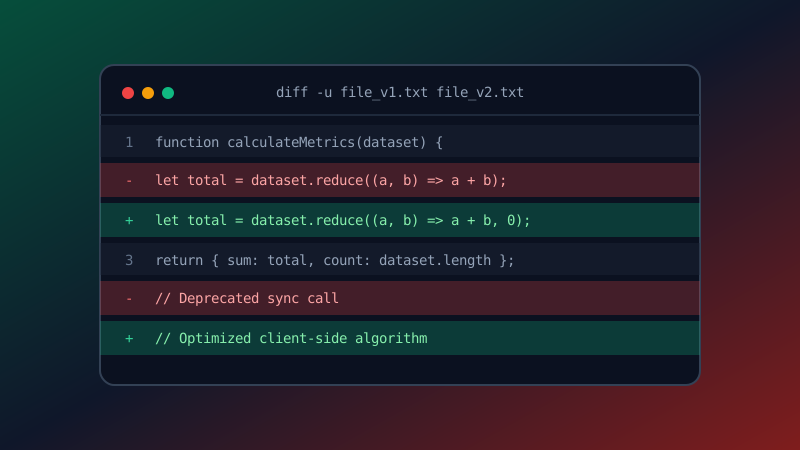
- Unified Diff Format: Compacts both versions into a single continuous stream. Added lines are prefixed with a green plus sign (
+), deleted lines are prefixed with a red minus sign (-), and contextual unchanged lines are left unadorned. This format is the global standard for Git patches and pull request reviews. - Side-by-Side (Split) Diff Format: Places the original file on the left and the modified version on the right, aligning matching lines horizontally. Split views are exceptionally effective when reviewing massive architectural refactors or comprehensive editorial rewrites.
5. Real-World Applications Beyond Code (Legal, Healthcare, Publishing)
While diffing was invented by software engineers, its mathematical principles have revolutionized non-technical professions:
- Legal Redlining: In corporate finance and contract law, opposing legal counsel exchange contract drafts with hundreds of pages. An automated diff tool guarantees that a counterparty has not inserted a stealth indemnity clause or modified a critical loan interest percentage.
- Publishing & Translation: Book editors and academic peer reviewers compare initial submissions against revised galleys to ensure author revisions have addressed all peer critiques accurately.
- Healthcare Regulatory Compliance: Pharmaceutical research teams track drug trial protocols and HIPAA patient authorization revisions across multiple clinical iterations.
6. Edge Cases: Whitespace, Line Endings, and Character Encodings
A diff tool is only as reliable as its handling of textual edge cases:
- CRLF vs. LF Line Endings: Windows operating systems terminate lines with Carriage Return + Line Feed (
\r\n), whereas macOS and Linux use simple Line Feed (\n). A naive diff tool comparing a Windows file to a Linux file will flag every single line as deleted and re-added. Robust tools normalize line endings before executing comparisons. - Trailing Whitespace & Tab vs. Space: If a developer changes four spaces to a tab, the code's visual rendering may remain identical, but a raw byte diff will report a conflict. Enabling Ignore Whitespace in our Text Diff Checker filters out these trivial indentation artifacts.
7. Client-Side Security in Modern Diff Workflows
Many legacy web-based diff tools require users to upload documents to external cloud servers where the comparison script executes via a remote backend process. For proprietary software codebases, trade secrets, and non-disclosure-bound legal contracts, transmitting text over public networks poses unacceptable compliance risks.
With ollrite Tools, the entire differencing pipeline executes in your client device's browser memory using native JavaScript. Zero text data is ever uploaded or cached on our servers. You can even disconnect your internet connection entirely after loading the page and continue diffing confidential files securely.
8. Conclusion: Choosing the Right Diff Strategy
Differencing algorithms represent a crowning achievement of applied computer science. By converting complex human document revisions into mathematically optimal edit scripts, diffing enables collaborative open-source development, guarantees contractual precision, and saves countless hours of manual proofreading.
Whether you need to review a Git commit patch, compare configuration files, or verify contract revisions, launch our free Text Diff Checker to inspect differences with complete client-side security.
Written by the ollrite Tools Editorial Team
We build fast, client-side developer utilities and publish deep-dive technical explorations into string manipulation, software algorithms, and web optimization. Have feedback? Email us at info@ollrite.com.